
Conversation with Gemini

transcript this text

SEO Implications of Each Choice

  • Does the site produce clean, semantic HTML with proper heading hierarchy? Both can – both can also fail.

  • Are meta tags, canonicals and schema implemented correctly? WordPress with Rank Math makes this easy; custom sites need explicit implementation.

  • Does the site achieve good Core Web Vitals? Performance depends on implementation quality, not the platform.

  • Is content manageable without developer involvement? WordPress wins here for most teams.

The SEO risk is in poor implementation on either platform, not the platform choice itself.

The Decision Framework

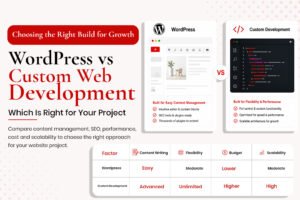
Choose WordPress If:

  • Non-technical team members will manage content

  • Budget is under $15,000 for initial development

  • Functionality requirements are standard

  • You want flexibility to work with any WordPress developer

now this

Choose Custom Development If:

  • The site is a web application with complex functionality CMS plugins cannot handle

  • Maximum performance is required

  • The data architecture is too complex for WordPress’s conventions

  • You have an in-house team to maintain the codebase

Frequently Asked Questions

Can WordPress be as fast as a custom site?

Yes, with a lightweight theme, caching plugin, fast host, locally hosted fonts, minimal plugins and optimised images – a well-built WordPress site can score 90+ on mobile PageSpeed.

Is WordPress good for SEO?

Yes, with Rank Math or Yoast configured correctly. The SEO capability is in the configuration, not the platform itself.

What does a WordPress SEO development project involve?

Architecture planning, theme selection or custom development, Rank Math configuration, schema implementation, Core Web Vitals optimisation, and sitemap setup.

now this

How Email Marketing Automation Increases Ecommerce Revenue (With Real Numbers)

Email marketing has a reputation as an older channel – something businesses do because they always have, not because it is the highest-performing option available. That reputation is wrong. Email’s average ROI of $40 for every $1 spent consistently outperforms paid social, paid search and display advertising. The reason is not the channel itself – it is the automation that makes the channel work without requiring constant human effort.

An email blast sent to a full list on a Tuesday is not email marketing automation. Automation is a system that sends the right email to the right person at the right moment based on what that person actually did – and does it without anyone pressing send.

How Ecommerce Email Automation Works

Email automation is event-driven. An event – a customer action or a time-based condition – triggers a flow. The flow sends a sequence of emails at predetermined intervals, with conditions that adjust based on the customer’s ongoing behaviour.

Example: a customer views a pair of trainers three times over two days, adds them to cart, then closes the browser. A properly configured system triggers a browse abandonment flow after the views, and an abandoned cart flow after the cart addition and abandonment – tailored to specific behaviour rather than a generic newsletter.

now this

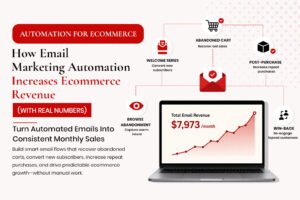
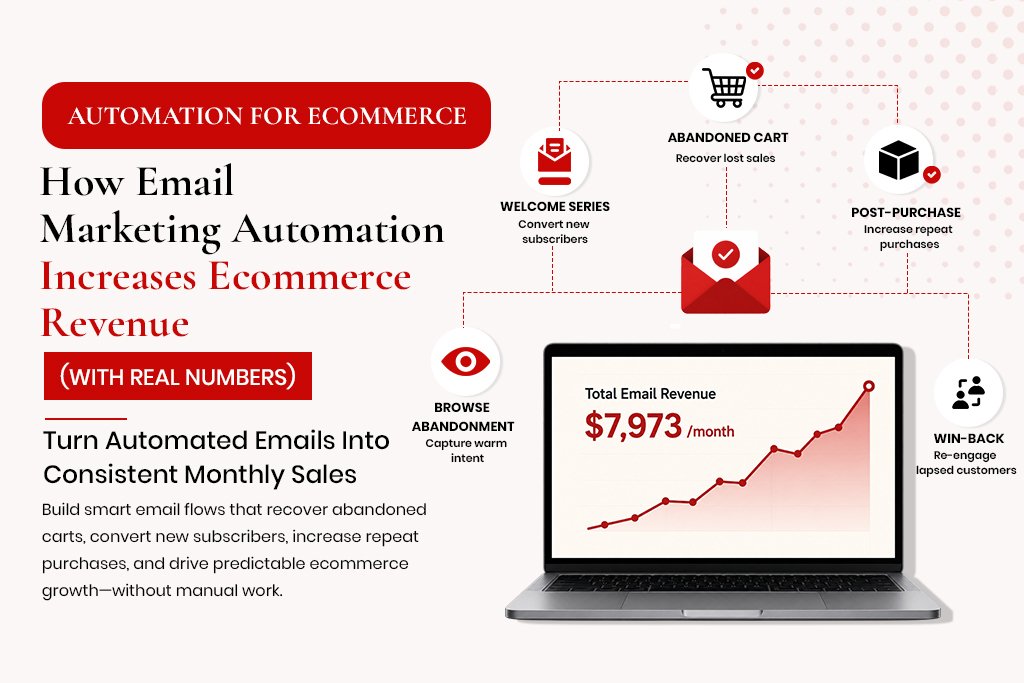
The 5 Flows That Drive 80% of Automated Email Revenue

1. Abandoned Cart – The Highest Revenue Flow

Between 70-80% of shopping carts are abandoned before purchase. A meaningful percentage abandoned because of a distraction or hesitation – recoverable revenue. A well-structured flow (three emails: 1 hour, 24 hours, 72 hours) typically recovers 5-15% of abandoned cart revenue. For a store with $80 AOV and 300 abandonment events monthly, that is 15-45 recovered orders – $1,200-$3,600 in monthly revenue running automatically.

Keys to performance: show the specific products left in cart, send the first email within 1 hour, avoid a discount in the first email (it trains customers to abandon for discounts), and make the CTA impossible to miss.

2. Welcome Series – Your Highest-Engagement Opportunity

Open rates for welcome emails average 50-60%, more than double standard campaigns. Welcome series typically generate 3-5% of total email revenue. For a store adding 500 subscribers monthly with a 10% first-purchase rate at $80 AOV, that is 50 sales monthly – $4,000 in attributed revenue.

3. Post-Purchase – Retention and Repeat Orders

Acquiring a new customer costs 5-7x more than retaining an existing one. A review request sent 10-14 days after delivery generates better reviews than one sent at purchase. Stores implementing post-purchase automation see 20-30% improvement in 90-day repeat purchase rates.

4. Browse Abandonment – Catching Warm Intent

A visitor viewing a product multiple times signals intent without adding to cart. A single email sent 4-6 hours after the session catches a meaningful percentage of warm-intent visitors, complementing cart abandonment recovery

5. Win-Back – Recovering Lapsed Customers

A customer who has not purchased in 180 days is at risk. A three-email win-back sequence (brand reminder, incentive, final goodbye) reactivates 10-20% of targeted lapsed customers. The goodbye email consistently outperforms the incentive email through loss aversion.

The Compound Effect of All 5 Flows Together

Flow Monthly Volume Conversion Rate Monthly Revenue
Abandoned Cart 300 events 8% recovery $1,920
Welcome Series 500 new subs 7% first purchase $2,800
Post-Purchase 150 orders 12% repeat in 30 days $1,440
Browse Abandonment 800 sessions 2% conversion $1,280
Win-Back (quarterly) 500 lapsed (/3) 12% reactivation $533
TOTAL $7,973/month

These numbers assume an $80 AOV at a store doing roughly $80-150K monthly revenue. Actual figures depend on niche, AOV and list quality, but the ratios are consistent across well-built systems.

Common Mistakes That Kill Email Automation Performance

  • Sending the first abandoned cart email too late – recovery drops 30-40% with delayed timing

  • Putting a discount in email 1 – trains customers to abandon for discounts

  • Not suppressing already-purchased customers from the abandoned cart flow

  • Ignoring list hygiene – sending to unengaged subscribers hurts deliverability for everyone

  • Using generic subject lines instead of specific, product-referencing ones

Frequently Asked Questions

How long does it take to set up email automation?

Welcome series and abandoned cart can be live in 8-12 hours. A full five-flow system takes 20-30 hours.

What email platform should I use for ecommerce automation?

Klaviyo is the strongest choice for Shopify and WooCommerce specifically, integrating natively and attributing revenue with accuracy.

How do I know if my email automation is working?

Track Klaviyo-attributed revenue – target 20-35% of total store revenue for a properly configured account.