
Digital Growth Strategy for Small Businesses: A Practical, No-Fluff Roadmap
‘Digital growth strategy’ sounds like something large companies hire consultants to produce in 80-page decks. In practice, it is a simpler question: what is the most effective way to use digital channels to grow this specific business?
The answer is different for every business. A local service business and a direct-to-consumer ecommerce brand have very different growth levers. But the framework for identifying the right approach and executing it consistently is the same.
Why Most Small Business Digital Growth Strategies Fail
The most common failure is lack of sequencing – businesses try website, paid ads, daily social posting, a podcast and SEO all simultaneously, spreading budget and attention across six channels and producing mediocre results everywhere.
The second is building on an unstable foundation – starting ads before the website converts, building an email list before there is anything worth sending, investing in content before the technical SEO infrastructure can help it rank.
The third is choosing the wrong primary channel. A B2B professional services firm does not grow through TikTok. Matching the channel to the business model is a decision that gets made wrong more often than it should.
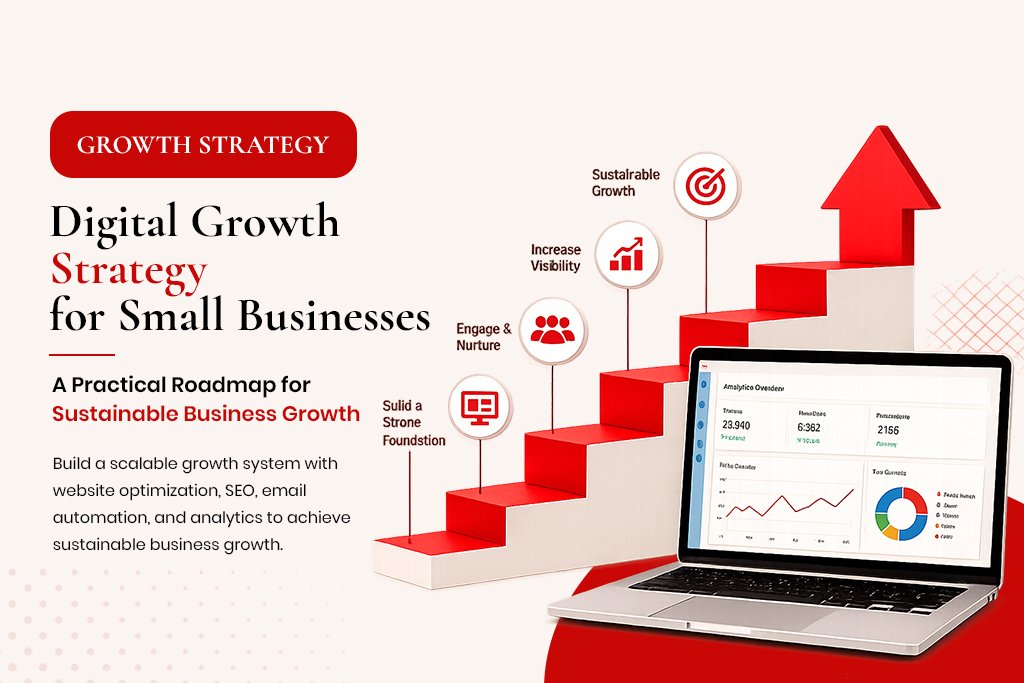
The Three Foundations Every Business Needs First
Foundation 1: A Website That Converts
A visitor should understand within 5 seconds what you do, who for, and what to do next. Common killers: unclear value proposition above the fold, no social proof, no direct call to action, load times over 4 seconds on mobile. Fix the website first – every channel drives traffic back to it.
Foundation 2: An SEO Infrastructure
SEO takes time to compound, which is exactly why it needs to start early. Clean architecture, proper meta tags, schema, a submitted sitemap and passing Core Web Vitals create the conditions for compounding organic growth over 12-24 months. Waiting until you ‘need SEO’ puts you 6-12 months behind where you could be.
Foundation 3: A Basic Email Capture and Nurture System
Every visitor who leaves without buying is potentially lost. An email capture system with an automated welcome sequence converts some of that traffic into future customers. The email list is the only audience you own – social reach depends on algorithms, paid traffic stops when budget stops.
Here is the complete transcription of the text from the image, organized exactly as it appears:
Choosing Your Primary Growth Channel
| Business Type | Best Primary Channel | Secondary Channel | Avoid Early |
| eCommerce (impulse, low AOV) | Paid Social | SEO + Email Automation | Podcast, LinkedIn |
| eCommerce (considered, high AOV) | SEO + Content | Email Automation | Impulse-driven social |
| Local Service Business | Google Business + Local SEO | Paid Search | Broad social media |
| B2B Professional Services | LinkedIn + Content SEO | Email Outreach | Paid Social, TikTok |
| SaaS / Digital Product | SEO + Content | Paid Search + Email | Broad social media |
The 12-Month Practical Roadmap
Months 1-2: Fix the Foundation
-
Website: fix conversion issues, mobile speed under 3 seconds, one clear CTA per page
-
SEO: install Rank Math, set up Search Console, submit sitemap, fix crawl errors
-
Email: set up your platform, add an opt-in form, write a 3-email welcome sequence
-
Analytics: confirm GA4 tracking and set up conversion goals
Here is the transcription of the text from the second image, continuing the roadmap structure:
Months 3-4: Add Content and Visibility
-
Publish two blog posts monthly targeting keywords customers actually search
-
Claim and optimise Google Business Profile if serving local customers
-
Begin link building – guest posts, directories, supplier or partner links
Months 5-8: Scale What Is Working
-
Review GA4 and Search Console data, invest more in what is gaining traction
-
Add browse abandonment and post-purchase flows if running ecommerce automation
-
Test paid search or paid social in a focused way – one campaign, one audience
Months 9-12: Compound and Optimise
-
Organic traffic from month 3 work should now be measurable and growing
-
Automate manual tasks – lead follow-up, reporting, onboarding
-
Review the full 12 months and base next year’s decisions on this year’s evidence
Setting Realistic Growth Milestones
-
Organic traffic: 3-6 months before meaningful growth, 9-12 months before it is a significant channel
-
Paid advertising: measurable results within 30-60 days with good creative and targeting
-
Email: the path from 0 to 1,000 subscribers is typically 6-12 months without a large existing audience
-
CRO: results often immediate, but need sufficient traffic to be statistically meaningful
Here is the transcription of the text from the third image:
The One Thing That Matters More Than Everything Else
Consistency. Businesses that fail at digital growth almost always stop before the compounding effect becomes visible – eight blog posts with no traffic and they stop, three weeks of ads with poor ROAS and they stop. Digital growth channels reward persistence disproportionately. Choose a level of activity you can sustain for 24 months – two blog posts monthly for two years beats twelve posts in month one and silence after.
Frequently Asked Questions
How much should a small business spend on digital marketing?
A common benchmark is 5-10% of annual revenue. For a business doing $500K annually, that is $25-50K per year, split based on evidence of what is working rather than equally across channels.
Should I do SEO or paid ads first?
Both serve different time horizons. Paid ads produce revenue in 30 days; SEO cannot. SEO needs to start now because it takes 6-9 months to compound. Most growing businesses run both.
Here is the transcription of the final section from the fourth image:
Do I need a digital marketing agency or can I do it myself?
Foundations are manageable solo if you have time to learn them. Ongoing execution – content, ad optimisation, link building, technical maintenance – is where an experienced specialist produces better results faster than a generalist working part-time.
What is the difference between digital marketing and digital growth?
Digital marketing is execution of specific tactics. Digital growth is the connected strategy tying those tactics into a system oriented toward a specific business outcome.